
Ask five people at your workplace what safety culture means and you’ll most likely receive five different answers. Some will point to policies and signage. Others will describe how people actually behave when nobody is watching. Both are part of the picture, but the whole story is something more.
Safety culture is essentially the sum of the shared values, attitudes and everyday behaviours that shape your approach to safety. It encapsulates your whole organisation and it’s not just about the approach from upper management. It matters because even the best policy won’t protect anyone if it isn’t there in how people actually work.
This post analyses what safety culture involves, why it really counts for WHS performance, and what you can do to strengthen it in workplaces of your own.
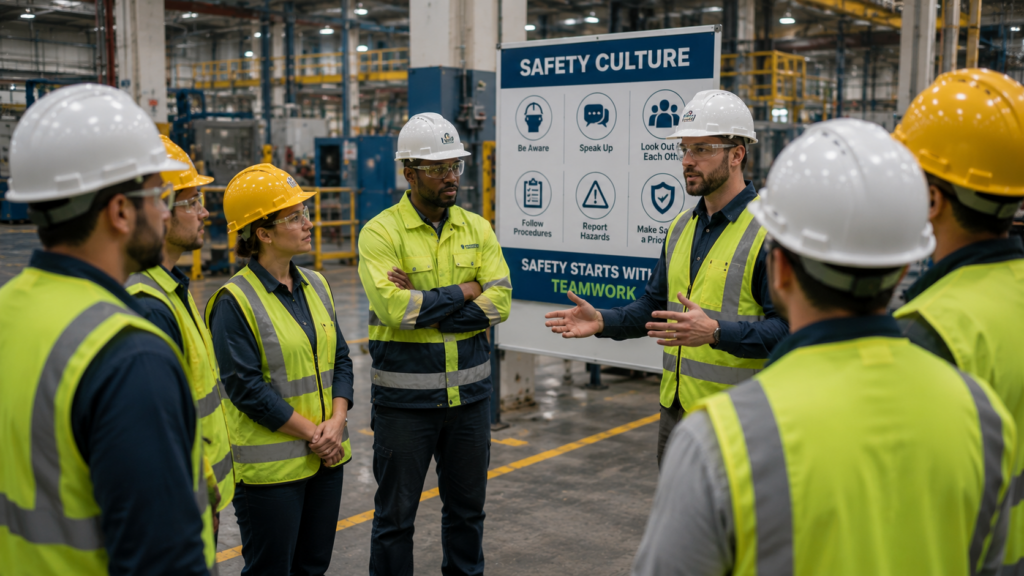
What is safety culture?
At its simplest, safety culture is the way things are carried out when it comes to safety. It covers the shared values, attitudes, beliefs and behaviours that determine whether safety is a genuine priority, or something people comply with only because they have to.
A strong safety culture is there to shape decisions long before an incident ever happens. It influences whether a worker stops a job they think is unsafe, whether a supervisor follows up on a reported hazard, and whether leadership backs a safety decision even when it’s not the fastest or cheapest. In short, it shapes the entire WHS environment and not what gets written in the manual.
The parts that make up a strong safety culture
Shared values and beliefs
A strong safety culture all starts with shared values. When everyone in a business – from the site floor to the boardroom – genuinely believes that no job is worth an injury, safety decisions become far more consistent. Without that shared belief, safety becomes something people comply with rather than something they actually value.
Attitudes and perceptions
Attitudes shape how seriously people take rules and procedures. A worker who sees safety as an obstacle to getting the job done quickly will behave very differently to one who sees it as part of doing the job properly. Changing these attitudes takes consistent messaging, alongside real follow through that goes beyond posters in the lunchroom.
Practices and behaviours
Culture eventually shows up in behaviour: whether people wear the right PPE without being told or whether they report near misses. These little day-to-day habits go a long way in revealing what an organisation’s safety culture actually looks like, far more than any policy document.
Leadership and management
Leaders set the tone. When managers visibly prioritise safety, turn up to toolbox talks, and follow the same rules they expect from everyone else, workers tend to take safety more seriously too. When leadership treats safety as an afterthought, that attitude permeates down regardless of what the policy manual says.
Accountability and responsibility
A safety culture only really works when responsibility is clear and shared. Employers need to provide safe systems of work that’s backed up by clear policies and procedures, while workers need to follow those procedures and speak up when something doesn’t align with them. Accountability that’s vague only leads to missed hazards, so blame becomes more common than prevention.
Open communication and reporting
Workers need to feel comfortable raising concerns without fear of blame. A clear, accessible incident management process for reporting hazards and near misses, and confidence that reports will actually be acted on, is one of the strongest indicators of a healthy safety culture.
Why is great safety culture non-negotiable?
Less accidents and injuries
Workplaces with a strong safety culture consistently record fewer accidents and injuries. When hazard reporting is encouraged and acted on quickly, problems get fixed before they cause harm, rather than after.
Improves workplace health and safety
Far beyond injury prevention, a strong safety culture supports long term health, covering everything from ergonomics to mental wellbeing. Workers who feel properly supported are less likely to push through fatigue or ignore early warning signs.
Better organisational performance
Safer workplaces are usually more productive workplaces. Fewer incidents mean less downtime, less disruption to schedules, and fewer resources being diverted to investigations and recovery.
Promotes regulatory compliance
A strong safety culture makes it far easier to meet WHS obligations, since safe behaviour becomes the norm rather than something enforced through checklists alone. This also lowers the risk of penalties or enforcement action down the track.
Naturally builds worker trust
Workers who trust that their safety is genuinely valued tend to be more engaged and more likely to stay. A positive safety culture contributes to a workplace people actually want to be part of, rather than one they simply tolerate.
Making safety culture a priority in your workplace
Building a stronger safety culture won’t happen overnight; it’s a handful of practical steps that really make the difference:
- Regular, relevant training: Generic annual sessions rarely stick. Training that reflects real tasks and real hazards is a far more effective way of getting information to stick.
- Leadership buy-in: Safety culture improves fastest when leaders are there throughout the process, not just signing off on policy from a distance.
- Anonymous reporting channels: Giving workers a way to raise concerns without attaching their name removes a common barrier to speaking up.
- Recognition for safe behaviour: Acknowledging workers who report hazards or follow procedures properly reinforces the behaviour you want to see, rather than only responding when something goes wrong.
Final thoughts
Safety culture is the accumulation of everyday decisions, behaviours and attitudes that shows how well your WHS system is working in practice.
Taking the time to assess where your safety culture currently sits and being honest about the gaps is the first step. WHS Monitor helps Australian organisations strengthen and remove friction from safety management by providing easy to access tools to report hazards and incidents, check asset and chemical registers, track training, manage reports, monitor compliance, and keep policies and processes accessible across teams.
With over 30 years of experience in risk and compliance, WHS Monitor supports more than 2,500 organisations across Australia to manage WHS obligations and build safer, more accountable workplaces. Explore our solutions today and contact our team today for a free demo.


Login to your Account