
Every business comes with risk. In industrial and construction sectors, that risk is so often physical and immediate. But across all businesses, there are strategic, financial, operational and compliance risks that can affect outcomes just as significantly.
ISO 31000 marks the international standard that provides a structured, consistent approach to managing all of it. This article covers what ISO 31000 risk management is, how it’s structured, what adopting it really brings to your organisation and how technology can help in the day-to-day application.

What is ISO 31000 risk management?
ISO 31000 is an international standard developed by the International Organisation for Standardisation (ISO) that provides principles and generic guidelines for managing any type of risk. The current version, ISO 31000:2018, builds on the earlier 2009 standard with more of a focus on leadership integration and continual improvement.
The part that makes it worth understanding is what ISO 31000 is not. It is not a compliance standard. Businesses cannot be certified against it and regulators do not mandate it directly. Instead, it provides a framework and set of principles that organisations can apply to any risk, in any context, at any scale.
If you’re a small construction firm, a large manufacturing operation, or a mid-sized services business, ISO 31000 risk management can be applied across your entire organisation or within specific functions. It doesn’t prescribe a single method. It gives you a structured way to think about and manage uncertainty.
The three distinct pillars of ISO 31000
ISO 31000 is built around three core components: principles, a framework and a process. Understanding how they work together is how you apply it in the correct way.
The principles
The principles set out and define what good risk management looks like. They establish that risk management should be integrated into business processes rather than treated as a separate function and that it should be part of decision-making at every level. Key principles include being structured and comprehensive, customised to the organisation’s context, inclusive of stakeholder input and responsive to change.
The framework
The framework provides the structure for embedding risk management across the organisation. It covers leadership and commitment, integration into business processes, design of the risk management system, implementation, and evaluation and improvement. The framework requires genuine commitment from leadership to work. Without it, the process layer has nothing to sit on.
The process
The process is the operational layer. It describes how risk management is actually applied day to day. This includes establishing context, identifying risks, analysing and evaluating them against risk criteria, and treating them with appropriate controls. Communication, monitoring, and review run throughout. This is the part your workers interact with most directly.
These three components work together as one. The principles guide the values. The framework builds the structure. The process is what actually happens in practice.
What ISO 31000 implementation helps you achieve
Adopting an ISO 31000 approach doesn’t just give your risk management a better structure. It changes how your organisation thinks about uncertainty.
- Improved decision-making: When risk is embedded in how you make decisions, you’re not responding to problems after they happen. You’re factoring in what could go wrong before you commit to a course of action.
- Enhanced organisational resilience: ISO 31000 risk management helps businesses anticipate disruption, not just respond to it. That means better continuity, faster recovery and more confidence from stakeholders when things don’t go to plan.
- Cost savings and efficiency: Avoiding costly errors is cheaper than correcting them. A structured approach to risk means fewer surprises, better allocation of resources and less time spent firefighting.
- Increased stakeholder confidence: Clients, investors and regulators take risk management seriously. A structured, internationally-aligned approach demonstrates that your business is being run responsibly.
- Facilitating compliance: ISO 31000 is not a compliance standard itself, but the structured approach it provides makes it easier to meet regulatory requirements. It aligns well with Australian WHS legislation and complements occupational health and safety management systems such as ISO 45001.
ISO 31000 and ISO 45001: Understanding the relationship
ISO 31000 and ISO 45001 are related but they are different. ISO 45001 is a certifiable standard specifically focused on occupational health and safety management systems. It’s designed to help organisations reduce workplace injuries and ill health.
ISO 31000, on the other hand, addresses risk management on a level that’s broader. It applies to any type of risk across any function of an organisation, not just OHS. The two standards complement each other well. ISO 45001 provides the OHS-specific framework, while ISO 31000 offers the comprehensive risk management principles that can be applied across the whole business. Many organisations find value in aligning their approach to both.
Leveraging technology for modern-day risk management
ISO 31000 provides the principles and structure. Putting them into practice across a real business requires systems that can handle the operational load consistently.
That’s where a platform like WHS Monitor becomes relevant. Managing risks in the right way means having consistent processes for identifying and documenting hazards, conducting risk assessments, tracking controls, managing incidents and maintaining records that reflect the current state of risk across the business.
Without the right tools, these processes are manual, inconsistent and easy to let slip. WHS Monitor brings together the key functions that support a structured risk management approach:
- Risk management: Identify, assess, and control risks with a structured, repeatable process.
- Policies and procedures: Document and distribute your safety framework so it’s accessible to everyone.
- Audits and inspections: Verify your controls are working and capture findings before they become incidents.
- Incident management: Record, investigate and learn from incidents to prevent recurrence.
- Reporting: Monitor performance and identify trends with accurate, real-time data.
Make a strategic investment in your businesses future
Risk isn’t going away. Every decision your business makes carries some level of uncertainty. The question isn’t whether you’ll face risks. It’s whether you’re managing them with any kind of structure, or just dealing with them as they appear.
WHS Monitor’s business risk and crisis management module assists your organisation build the risk management structure required by ISO 31000. It helps businesses of all sizes move from reactive to proactive, from informal to systematic, and from guesswork to informed decision-making. Adopting this approach is a long-term investment. It builds resilience, supports compliance, and creates a foundation for more confident leadership.
If you’re looking to bring more structure to your risk management approach, WHS Monitor gives you the practical tools to make it work in practice. Contact our team today for a free demo.
Hazardous Chemical Register: Why It’s Essential for Workplace Safety
Everything you need to know about choosing the right HSEQ management system; from scoping your…
What is Health and Safety in the Workplace? A Comprehensive Guide
Everything you need to know about choosing the right HSEQ management system; from scoping your…

What Is the Work Health and Safety Act 2011? A Full Guide for Australian Employers
Everything you need to know about choosing the right HSEQ management system; from scoping your…

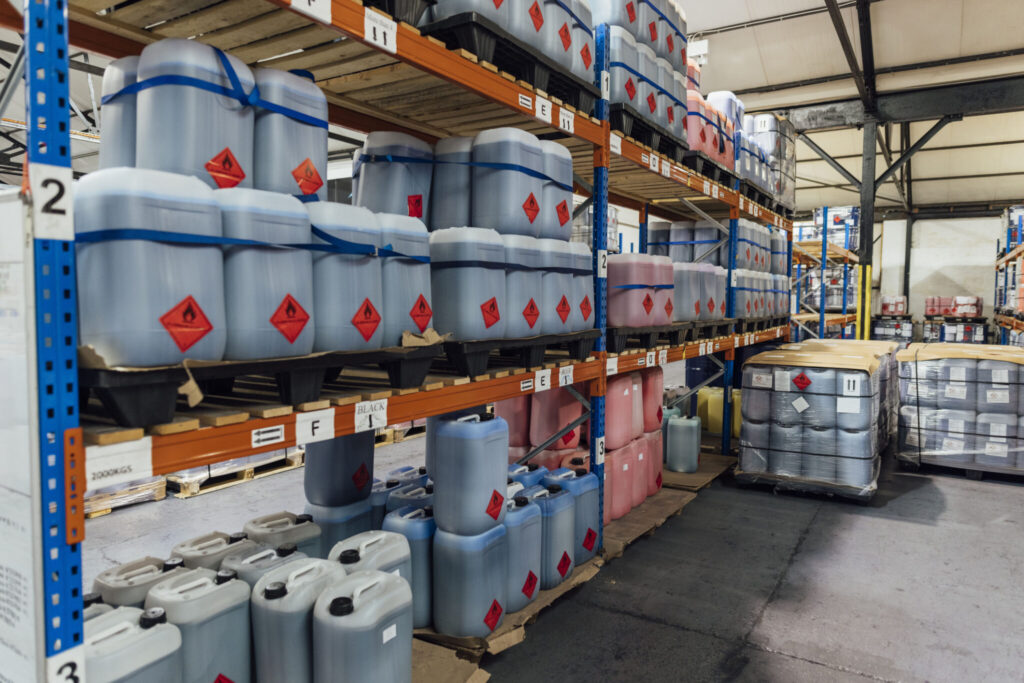
Many industrial, construction and business environments handle hazardous chemicals every working day. It might be cleaning agents, fuels, industrial solvents, or raw materials – whatever it is, these substances are part of the job. But handling them safely isn’t just about common sense. A structured approach to chemical management is needed, one that protects workers and keeps your business on the right side of the law.
At the centre of that approach is the hazardous chemical register. Understanding what it is, what goes into it and why it really matters could be the difference between a safe, compliant operation and a serious incident.
What are chemical hazards in the workplace?
A chemical hazard is any solid, liquid, or gas that has the potential to cause harm to people or property. That covers a lot of ground. In the wrong conditions, even substances used in everyday operations can become dangerous.
The types of harm they can cause fall into a few categories:
- Acute health effects: These happen quickly after exposure. Think burns, poisoning, eye irritation, or respiratory distress.
- Chronic health effects: These develop over time. Long-term exposure to certain chemicals can lead to serious conditions, including occupational asthma, respiratory disease, or cancer.
- Physical hazards: Some chemicals create fire risks, explosion hazards, or cause corrosion to equipment and infrastructure.
Recognising these risks isn’t optional for decision-makers in industrial and construction businesses; it’s part of your duty of care.
What is a hazardous chemical register?
A hazardous chemical register is a comprehensive list of all hazardous chemicals that are stored, handled, or used at a workplace. It doesn’t matter whether those chemicals are used daily or kept in a storage room. If they’re on site, they belong on the register.
The purpose is straightforward. Workers and emergency services need to be able to access critical safety information quickly. In an emergency, knowing exactly what chemicals are present, where they are stored, and how to respond can be enough to prevent a dangerous situation from becoming much worse.
Under Australian workplace health and safety legislation, any business that stores, handles, or uses hazardous chemicals is legally required to prepare, maintain and provide access to a hazardous chemical register. You can’t view this as a simple box-ticking exercise. This is a legal obligation, and one that regulators take seriously.
Safe Work Australia provides comprehensive guidance on hazardous chemical records and signs in workplaces. State regulators including WorkSafe Queensland and WorkSafe WA also offer jurisdiction-specific guidance on what is required.
The integral role of safety data sheets (SDS)
The hazardous chemical register doesn’t stand alone. For every chemical listed, the register must include the current safety data sheet (SDS).
An SDS is a document provided by the manufacturer or supplier that details everything workers and emergency responders need to know about a particular chemical. It covers:
- Hazardous properties, including flammability, toxicity, and reactivity
- Safe handling and storage instructions
- Emergency procedures, including spill clean-up, first aid, and firefighting guidance
- Personal protective equipment (PPE) requirements
An SDS that is outdated or missing is not just a compliance gap. It puts workers at risk. SDS updating needs to be a regular part of your chemical management process. When a supplier revises an SDS, your register needs to be a reflection of that change.
WHS Monitor’s chemical management module makes this much easier. Maintain a live, accurate register with usable chemical data including, quantity stored, storage information, automatic segregation alerts, quick reference hazard and PPE charts as well as auditable SDS documents. This ensures your team always has access to the right information to keep your records audit-ready.
Keeping your hazardous chemical register accurate
A hazardous chemical register is only as useful as its accuracy. There are a few clear best practices that keep it working the way it should.
Always keep the register current. Any time a new chemical is introduced to the workplace, it must be added before use. When a chemical is removed or replaced, update the register to reflect that.
Make it accessible. The register must be available to all workers and emergency personnel at all times. A digital register accessible from any device is far more practical than a folder in the safety manager’s office.
Review it regularly. Don’t wait for something to go wrong. Set a schedule for routine reviews, particularly after any changes to operations, suppliers, or products.
Connect it to your broader risk management approach. The hazardous chemical register and the SDS documents within it feed directly into risk assessments. The information they contain helps identify what control measures are needed and whether current controls are adequate. Without an accurate register, you cannot conduct a thorough risk assessment. Without a thorough risk assessment, your control measures are guesswork.
Stay committed to chemical safety
A well-maintained hazardous chemical register is one of the foundations of chemical safety in any workplace. It protects workers, supports emergency responders and demonstrates to regulators that your business takes its obligations seriously.
Getting this right requires consistency. That means keeping your register current, keeping SDS documents up to date and making access as easy as possible.
WHS Monitor’s chemical management solution brings together hazardous chemical registers, automatic SDS updates, chemical risk, chemical segregation and a proprietary chemical mixing tool into one comprehensive module. WHS Monitor also allows registers to be easily accessed by all personnel, without the need for sign in, by scanning QR and NFC enabled Q-Tap digital labels attached to each cemical storage. If you’re looking to simplify your chemical management processes, contact our team today for a free demo.
This is a question that comes up more often than you’d expect. What exactly is health and safety in the workplace? And what does it actually mean for your business?
The short answer is that it’s something beyond legal compliance. At its core, health and safety in the workplace is about protecting people. Your workers, your contractors, your visitors, and yes, your business itself. Done well, it shapes the culture, the confidence and the long-term performance of any organisation.
This guide breaks down what health and safety actually involves, why it matters for decision-makers in industrial, construction, and business environments, and what a strong WHS framework looks like in practice.

Clearly defining health and safety in the workplace
Health and safety in the workplace refers to the discipline concerned with protecting the health, safety, and welfare of people engaged in work or employment. That’s the comprehensive definition, but it’s one that covers a wide range of ground so let’s separate it into two components.
Health is all about preventing work-related illness and long-term harm. Respiratory conditions from chemical exposure, hearing loss from prolonged noise, musculoskeletal injuries from repetitive tasks, and psychological harm from workplace stress all fall under this category.
Safety shifts the focus to preventing injuries, accidents and immediate physical harm. Slips, falls, machinery accidents, cuts, burns and crush injuries are the kinds of incidents a strong safety system is put in place to prevent.
Both are equally important. A business that focuses only on preventing acute injuries but ignores long-term health risks is doing half the job, so a holistic approach is always the most effective.
Why health and safety matters for your business
This might seem obvious, but there’s a lot more to this than you might initially think. There’s a tendency to treat WHS as a compliance burden. Something you do because you have to, not because it actually delivers value. That’s the wrong way to look at it. The benefits of strong health and safety in the workplace go well beyond avoiding fines:
- Legal compliance: Businesses in Australia have clear obligations under work health and safety legislation. Meeting those obligations protects you from penalties, investigations, and legal action.
- Employee wellbeing: Your workers are your most valuable asset. A workplace that keeps them safe and healthy retains their trust and their capability.
- Productivity and efficiency: Fewer incidents mean less downtime. When people aren’t dealing with injuries, investigations, or recovery periods, they’re working.
- Financial savings: Workplace incidents are expensive. Compensation claims, legal costs, insurance premiums, and the cost of replacing injured workers add up quickly.
- Reputation and trust: Clients, partners, and prospective workers pay attention to safety records. A strong safety culture builds confidence in your business.
- Morale and retention: Workers stay in places where they feel safe. High turnover is often a symptom of a poor safety culture, not just low pay.
These aren’t abstract benefits. They show up in your bottom line, your staff headcount and your ability to win and maintain the important contracts.
Building a robust health and safety framework
Knowing what health and safety in the workplace means is one thing. Building a system that actually delivers it is another. Effective WHS management requires several components working together.
Risk management
Risk management is the foundation. This means identifying hazards across physical, chemical, ergonomic, biological, and psychological categories, assessing the likelihood and severity of harm, and then implementing control measures to eliminate or reduce those risks. Without systematic risk management, everything else is reactive.
Policies and procedures
Clearly defined safety policies set expectations across the business, and documented safe work procedures ensure tasks are performed the right way, every time. Workers shouldn’t have to guess what the safe approach is. It should be written down and accessible.
Training and competence
Knowing the rules and being able to follow them in practice are not the same thing. Workers need training that is relevant to their role, their environment, and the specific hazards they face. Regular refresher training keeps that knowledge current and prevents it from drifting.
Consultation and participation
Workers who are involved in safety decisions are more invested in the outcomes. Establishing health and safety representatives or safety committees is a practical way to bring workers into the process. Their on-the-ground knowledge often surfaces risks that managers miss.
Incident management
Clear procedures for reporting and investigating incidents are essential, but so is learning from them. An incident is data. If you’re not using it to prevent the next one, you’re wasting an opportunity. Timely and accurate incident management also helps you meet notification obligations under WHS legislation.
Audits and inspections
Regular audits and inspections verify that your systems and controls are actually working, not just documented. They help identify gaps before they result in an incident, and they provide evidence of due diligence that can be critical if your safety practices are ever scrutinised.
Reporting
Accurate records of incidents, training, risk assessments, and audits and inspections paints a clear picture of how your safety system is performing over time. They’re also essential for demonstrating compliance if you’re ever subject to investigation.
The role you play as a decision-maker in health and safety
Health and safety in the workplace doesn’t start on the shop floor. It starts right at the top and permeates down.
As an employer or decision-maker, your responsibilities include providing a safe work environment, ensuring workers have the training and supervision they need, allocating adequate resources to safety, and building a culture where safety is treated as a genuine priority. When leadership takes it seriously, workers follow. When they don’t, no amount of policy writing compensates.
WHS Monitor gives decision-makers the tools to make all of this manageable in practice. From risk management and incident management to audits and inspections, reporting, policies and procedures, people management and most importantly reporting, keeping everything you need in one platform removes the friction that leads to obstacles.
Investing in a safer workplace for all
You can’t think of a strong health and safety culture in the workplace as an expense. It’s an investment in your people, your productivity and your reputation.
Businesses that take WHS seriously perform better. They retain workers, avoid costly incidents and naturally build the kind of trust that supports long-term growth. The ones that treat it as a grudging compliance exercise tend to find out the hard way why it matters.
If you’re looking at your current safety practices and thinking there’s room to improve, contact WHS Monitor today for a free demo and see how our platform can support a safer, more compliant workplace.
Every Australian business has legal obligations when it comes to keeping people safe at work. In many cases, most of those obligations trace back to one piece of legislation; the Work Health and Safety Act 2011. This is generally known as the WHS Act and acts as Australia’s primary work health and safety law, applying to almost everything from small trades businesses to large government departments.
This post walks through what’s actually covered in the WHS Act, who it applies to, and the key duties that should be carried out by employers, officers and workers.

What is the Work Health and Safety Act 2011?
The WHS Act provides a full legal framework for protecting the health, safety and welfare of workers across Australia. It maps out the duties that businesses, officers and workers owe to each other, alongside the standards every workplace is expected to meet.
One of the Act’s main aims is consistency. Before harmonisation, WHS laws varied considerably between states and territories, which made compliance harder for businesses operating across borders. The WHS Act, adopted with some variation across most Australian jurisdictions, was designed to bring these laws into closer alignment.
The Act applies broadly. It covers employees, contractors, volunteers and even visitors to a workplace, reflecting the fact that safety obligations do not stop at the edge of an employment contract.
The purpose and scope of the WHS Act
Worker protection
Right at the core, the WHS Act is there to prevent harm. It does this by setting out clear duties and expectations for everyone involved in a workplace, rather than leaving safety to informal goodwill.
A nationally consistent framework
The Act forms part of a broader push to harmonise WHS laws across Australian states and territories. Most jurisdictions adopted the model laws between 2011 and 2012, and Western Australia followed later, moving to harmonised WHS legislation in 2022 after operating under its own separate occupational safety and health laws for decades. Some minor differences between jurisdictions still remain, but businesses now face a far more consistent set of rules than they did before harmonisation began.
Broad application
The WHS Act isn’t limited to any one industry. It applies to construction sites and office buildings, warehouses and hospitals, covering every type of worker and workplace arrangement.
Knowing the key principles and your legal duties
Primary duty of care (for PCBUs)
A person conducting a business or undertaking, referred to in the Act as a PCBU, carries the primary duty of care. This means ensuring, so far as is reasonably practicable, that workers and others are not exposed to health and safety risks arising from the business.
Reasonably practicable
You will see the phrase reasonably practicable throughout WHS legislation. In plain terms, it means doing what is realistically possible to eliminate or minimise a risk, weighing up the likelihood and severity of harm, what is known about managing it, and the cost and effort involved.
In practice, this usually means a business cannot simply argue that a control measure was too expensive or inconvenient if a more effective option was reasonably available. Regulators and courts look at what a business knew, or ought to have known, at the time, not just what was easiest.
Duties of officers
Company directors and other officers carry their own due diligence obligations under the Act. This means actively taking reasonable steps to understand WHS risks and making sure the business has the right processes in place, rather than delegating safety to someone else and stepping back entirely.
Duties of workers
Under the occupational health and safety act employees must also play their part in keeping the workplace safe. Workers are required to take reasonable care for their own safety and the safety of others, follow reasonable instructions, and cooperate with the policies and procedures their employer has put in place. This includes reporting hazards and incidents promptly through the right incident management channels, rather than letting problems go unreported.
What the WHS Act covers
Beyond the core duties, the WHS Act includes several features that shape how workplaces carry out business day to day:
- Worker consultation: Businesses must consult workers on decisions that affect their health and safety, rather than deciding safety matters unilaterally.
- Incident notifications: Certain incidents, generally serious injuries, illnesses or dangerous occurrences, must be reported to the relevant regulator without delay.
- Compliance and enforcement: WHS inspectors have the power to investigate workplaces, issue notices and pursue penalties where businesses fail to meet their obligations.
- Right to cease unsafe work: Workers are entitled to stop work, or refuse to carry it out, if they have a reasonable concern about a serious risk to their health or safety.
- Protections and prohibitions: The Act protects health and safety representatives from being disadvantaged for doing their job, and prohibits anyone from interfering with a person carrying out a safety duty.
Why the WHS Act matters for Australian workplacesThe WHS Act gives Australian businesses a clear, consistent set of expectations to work towards. Meeting these obligations is not just about avoiding penalties. Businesses that take the Act seriously tend to build stronger safety cultures, experience fewer incidents and develop better relationships with their workforce.
For employers, that generally means clear documentation, regular consultation with workers, and a genuine willingness to act on hazards once they are reported. For workers, it means understanding that safety is a shared responsibility, not something that sits with management alone.
Staying compliant is an ongoing task rather than a one-off exercise, particularly as regulations are updated and workplaces change over time. Ongoing training, alongside a solid approach to risk management, goes a long way towards keeping a business on the right side of the Act.
Final thoughts
The Work Health and Safety Act 2011 sets out who is responsible for safety in an Australian workplace, and what that responsibility actually involves. Understanding these duties – and importantly applying them on a consistent basis – is central to running a safe and compliant business.
Explore WHS Monitor’s solutions to see how the right systems can help you meet these obligations day to day, and keep your business compliant under the WHS Act well beyond the next audit.
From managing policies and procedures through a centralised document library to keeping legislation, safety plans, and compliance records up to date, WHS Monitor gives your team access to the information they need, wherever work takes place. Contact our team today for a free demo and change the way you approach workplace safety forever.
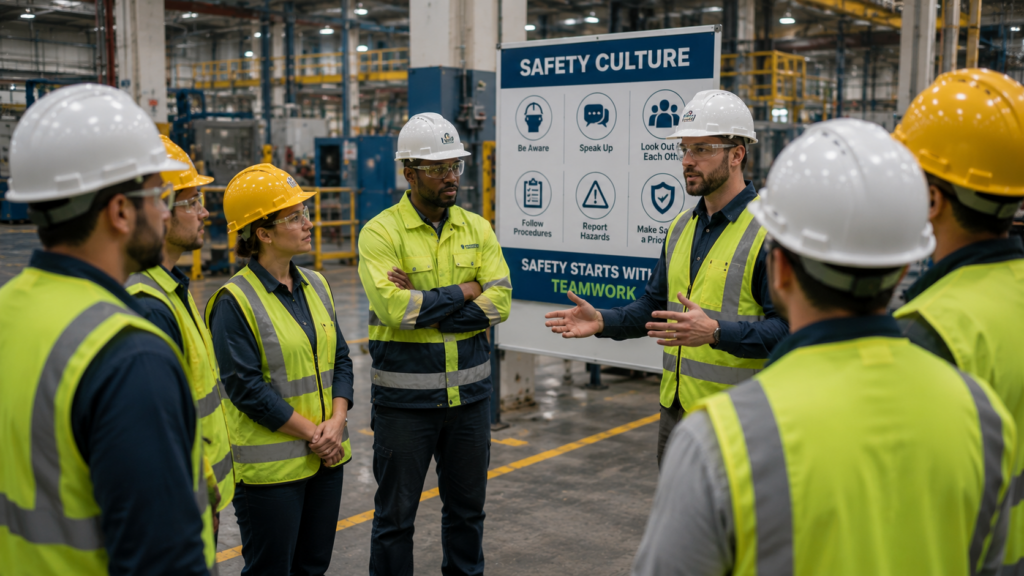
Ask five people at your workplace what safety culture means and you’ll most likely receive five different answers. Some will point to policies and signage. Others will describe how people actually behave when nobody is watching. Both are part of the picture, but the whole story is something more.
Safety culture is essentially the sum of the shared values, attitudes and everyday behaviours that shape your approach to safety. It encapsulates your whole organisation and it’s not just about the approach from upper management. It matters because even the best policy won’t protect anyone if it isn’t there in how people actually work.
This post analyses what safety culture involves, why it really counts for WHS performance, and what you can do to strengthen it in workplaces of your own.
What is safety culture?
At its simplest, safety culture is the way things are carried out when it comes to safety. It covers the shared values, attitudes, beliefs and behaviours that determine whether safety is a genuine priority, or something people comply with only because they have to.
A strong safety culture is there to shape decisions long before an incident ever happens. It influences whether a worker stops a job they think is unsafe, whether a supervisor follows up on a reported hazard, and whether leadership backs a safety decision even when it’s not the fastest or cheapest. In short, it shapes the entire WHS environment and not what gets written in the manual.
The parts that make up a strong safety culture
Shared values and beliefs
A strong safety culture all starts with shared values. When everyone in a business – from the site floor to the boardroom – genuinely believes that no job is worth an injury, safety decisions become far more consistent. Without that shared belief, safety becomes something people comply with rather than something they actually value.
Attitudes and perceptions
Attitudes shape how seriously people take rules and procedures. A worker who sees safety as an obstacle to getting the job done quickly will behave very differently to one who sees it as part of doing the job properly. Changing these attitudes takes consistent messaging, alongside real follow through that goes beyond posters in the lunchroom.
Practices and behaviours
Culture eventually shows up in behaviour: whether people wear the right PPE without being told or whether they report near misses. These little day-to-day habits go a long way in revealing what an organisation’s safety culture actually looks like, far more than any policy document.
Leadership and management
Leaders set the tone. When managers visibly prioritise safety, turn up to toolbox talks, and follow the same rules they expect from everyone else, workers tend to take safety more seriously too. When leadership treats safety as an afterthought, that attitude permeates down regardless of what the policy manual says.
Accountability and responsibility
A safety culture only really works when responsibility is clear and shared. Employers need to provide safe systems of work that’s backed up by clear policies and procedures, while workers need to follow those procedures and speak up when something doesn’t align with them. Accountability that’s vague only leads to missed hazards, so blame becomes more common than prevention.
Open communication and reporting
Workers need to feel comfortable raising concerns without fear of blame. A clear, accessible incident management process for reporting hazards and near misses, and confidence that reports will actually be acted on, is one of the strongest indicators of a healthy safety culture.
Why is great safety culture non-negotiable?
Less accidents and injuries
Workplaces with a strong safety culture consistently record fewer accidents and injuries. When hazard reporting is encouraged and acted on quickly, problems get fixed before they cause harm, rather than after.
Improves workplace health and safety
Far beyond injury prevention, a strong safety culture supports long term health, covering everything from ergonomics to mental wellbeing. Workers who feel properly supported are less likely to push through fatigue or ignore early warning signs.
Better organisational performance
Safer workplaces are usually more productive workplaces. Fewer incidents mean less downtime, less disruption to schedules, and fewer resources being diverted to investigations and recovery.
Promotes regulatory compliance
A strong safety culture makes it far easier to meet WHS obligations, since safe behaviour becomes the norm rather than something enforced through checklists alone. This also lowers the risk of penalties or enforcement action down the track.
Naturally builds worker trust
Workers who trust that their safety is genuinely valued tend to be more engaged and more likely to stay. A positive safety culture contributes to a workplace people actually want to be part of, rather than one they simply tolerate.
Making safety culture a priority in your workplace
Building a stronger safety culture won’t happen overnight; it’s a handful of practical steps that really make the difference:
- Regular, relevant training: Generic annual sessions rarely stick. Training that reflects real tasks and real hazards is a far more effective way of getting information to stick.
- Leadership buy-in: Safety culture improves fastest when leaders are there throughout the process, not just signing off on policy from a distance.
- Anonymous reporting channels: Giving workers a way to raise concerns without attaching their name removes a common barrier to speaking up.
- Recognition for safe behaviour: Acknowledging workers who report hazards or follow procedures properly reinforces the behaviour you want to see, rather than only responding when something goes wrong.
Final thoughts
Safety culture is the accumulation of everyday decisions, behaviours and attitudes that shows how well your WHS system is working in practice.
Taking the time to assess where your safety culture currently sits and being honest about the gaps is the first step. WHS Monitor helps Australian organisations strengthen and remove friction from safety management by providing easy to access tools to report hazards and incidents, check asset and chemical registers, track training, manage reports, monitor compliance, and keep policies and processes accessible across teams.
With over 30 years of experience in risk and compliance, WHS Monitor supports more than 2,500 organisations across Australia to manage WHS obligations and build safer, more accountable workplaces. Explore our solutions today and contact our team today for a free demo.
A successful workplace is a safe one. Without the right safety measures ready and waiting, businesses face increased risk, reduced productivity and potential harm to their workforce. Workplace hazards lie central to understanding safety risk. In simple terms, this is anything in the work environment that has the potential to cause harm.
This guide outlines what we mean by workplace hazards, providing a practical list of potential hazards and outlining how decision-makers in industrial, construction, and commercial environments can identify and manage them.
What are workplace hazards?
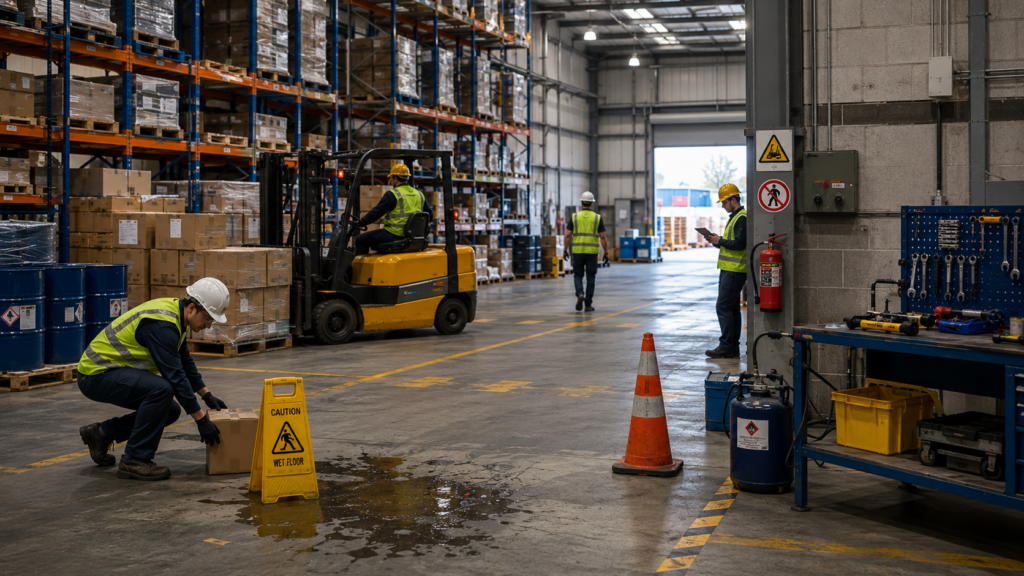
So, what are workplace hazards? A workplace hazard is any object, material, situation, or activity that has the potential to cause injury, illness, or property damage. Hazards are there in any workplace and across all industries, regardless of size or complexity. Without proper planning and control, workplace hazards can quickly lead to:
- Workplace injuries and accidents.
- Lost productivity and operational downtime.
- Financial losses and legal consequences.
- Reputational damage.
- Increased insurance and compliance costs.
Risk management is nothing without understanding hazards that cause them.
Categorising the common workplace hazards
Workplace hazards are often grouped into categories to help organisations better understand, identify, and control risk. While traditional WHS frameworks separate hazards into distinct types, in practice many risks overlap and fall under broader environmental conditions that affect both physical and psychological wellbeing.
In Work Health and Safety (WHS), environmental hazards can be understood as the overarching category that includes physical, chemical, biological, and psychosocial factors present in the workplace environment. These hazards can cause physical injury, illness, or psychological distress, and must be managed using the hierarchy of controls.
Environmental Hazards (Umbrella Category)
Environmental hazards in WHS refer to workplace conditions that can cause physical harm, disease, or psychological stress. Under WHS legislation, employers have a duty to eliminate or minimise these risks so far as is reasonably practicable.
These hazards can be grouped into several key areas:
Thermal Conditions
Exposure to extreme heat or cold that can lead to heat stress, heatstroke, hypothermia, or frostbite.
Examples include:
- Outdoor work in extreme weather
- Poorly ventilated indoor environments
- Industrial heat sources
Air Quality and Atmospheric Conditions
Exposure to airborne contaminants that affect respiratory health.
Examples include:
- Bushfire smoke
- Dust storms
- Silica dust
- Chemical management and toxic gases
- Poor ventilation in enclosed spaces
Physical Environmental Factors
Workplace conditions that can cause harm through exposure rather than direct contact.
Examples include:
- Excessive noise levels
- Continuous vibration exposure
- Poor or inadequate lighting
- Unsafe workspace layout or design
Hazardous Materials and Substances
Exposure to harmful substances in solid, liquid, gas, or biological form.
Examples include:
- Toxic chemicals and solvents
- Corrosive substances
- Lead exposure in air, soil, or water
- Biological agents such as bacteria or mould
This area is closely linked to effective chemical management and controlled handling procedures.
Psychosocial and Organisational Factors
Workplace conditions that impact mental health, stress levels, and wellbeing.
Examples include:
- High workload or time pressure
- Isolation or remote working conditions
- Poorly designed rest or recovery facilities
- Exposure to traumatic or high-stress environments
- Lack of support or organisational clarity
Managing and preventing workplace hazards
Keeping on top of workplace hazards means taking a structured, proactive approach to organisational risk management.
Regular hazard identification and risk assessments
Routine inspections and structured reviews are there to identify hazards before they result in harm.
Risk control measures
Using the hierarchy of controls to reduce risk:
- Elimination of hazards
- Substitution with safer alternatives
- Engineering controls (barriers, isolation, ventilation)
- Administrative controls (procedures, training, scheduling)
- PPE as a final layer of protection
Continuous training and awareness
All workers must understand hazards that are relevant to their role and how to apply safe systems of work.
Consultation and communication
Engaging workers in safety decisions improves hazard identification and practical risk control.
Digital WHS tools
Modern WHS systems, such as apps like WHS Monitor, help organisations streamline hazard reporting, risk assessments, and compliance tracking across all work environments and industries.
In addition to improving visibility and oversight of safety performance, these tools also include standardised control libraries that allow teams to quickly apply proven risk controls to identified hazards. This helps ensure consistency in how risks are managed and reduces reliance on ad hoc decision-making.
WHS Monitor also supports structured corrective actions, enabling organisations to assign, track, and close out safety issues efficiently, ensuring hazards are not only identified but actively resolved in line with WHS requirements.
The first step in building safer workplaces
Understanding and managing workplace hazards is so much more than a compliance requirement; it’s a critical part of all responsible business operations.
Flagging hazards early and implementing effective controls enables an organisation to:
- Protect workers from harm
- Improve operational efficiency
- Reduce downtime and costs
- Strengthen long-term safety performance across all industries
Strong risk management that’s supported by clear systems, effective chemical management and modern WHS tools create safer, more resilient workplaces.
Solutions like WHS Monitor provide a practical way to rethink workplace health and safety. Contact us for a free trial and start protecting the things that really matter.
Codes of practice make up an important part of Australian Work Health and Safety (WHS) legislation. Fundamentally, they offer real-world practical guidance on how to meet legal safety obligations in the workplace.
Rather than introducing new laws, they explain how to apply existing WHS requirements in everyday situations. This makes them a key resource for developing consistent safe work practices, improving compliance and maintaining a safe working environment.

What are codes of practice?
Think of codes of practice as practical guides that explain how to achieve the standards required under WHS laws. A WHS code of practice outlines a detailed, step-by-step guide on managing specific workplace hazards or work activities. These documents support duty holders in understanding how to meet their legal obligations in a way that’s practical and structured.
Importantly, a WHS code of practice isn’t law itself; it’s an approved way of demonstrating compliance with WHS legislation. Following an approved code is looked upon as strong evidence that a business has met its WHS duties.
What’s contained within a code of practice
Codes of practice support organisations in identifying hazards, assessing risks and implementing the right controls. They outline how to meet the required standards under the WHS Act and Regulations, translating legal obligations into practical workplace action. Codes of practice include:
- Explanatory information about hazards and risk types.
- Recommended safe work practices for managing risks.
- References to WHS legislation and relevant Australian Standards.
These documents are often used alongside workplace policies and procedures for safety requirements that are clearly defined and consistently applied.
Understanding legal standing
Although codes of practice aren’t legally binding, they do come with significant legal weight. They are admissible in court proceedings and may be used as evidence when determining WHS compliance. Courts may refer to codes of practice to:
- Understand known hazards and associated risks.
- Identify appropriate control measures.
- Determine what is considered “reasonably practicable” in a given situation.
As a result, codes of practice are often used as a benchmark for acceptable workplace safety standards.
Practical examples of codes of practice
There are many WHS codes of practice in Australia covering a wide range of industries and hazards. Common examples include:
- Managing Confined Spaces
- Hazardous Manual Tasks
- Managing Electrical Risks in the Workplace
- Managing the Risk of Falls at Workplaces
- How to Manage Work Health and Safety Risks
- How to Manage and Control Asbestos in the Workplace
- Managing Psychosocial Hazards at Work
A full list of approved codes of practice can be found on Safe Work Australia and through state and territory regulators such as SafeWork NSW, WorkSafe QLD, WorkSafe WA, SafeWork SA and Comcare.
Do you have to keep your business compliant?
Compliance with a WHS code of practice isn’t actually mandatory, provided an organisation can demonstrate an equal or higher standard of risk management through other means.
Duty holders may opt for alternative methods to manage risks, but workplace hazards must always be identified and controlled. Codes of practice should therefore be viewed as practical guidance rather than strict legal requirements. However, they are widely used as a benchmark for developing safe work practices and supporting structured risk management systems.
They are also commonly referenced during audits and inspections, where regulators assess how effectively risks are being managed in line with WHS expectations.
The impact of jurisdictional differences
While WHS laws are largely harmonised across Australia, there can still be differences between jurisdictions in the specific codes of practice that are approved or adopted.
This means that a WHS code of practice in one state or territory may not be identical to those in another.
For this reason, organisations should always check with their local WHS regulator to confirm which codes of practice apply in their jurisdiction.
Final thoughts
Codes of practice are a critical part of the Australian WHS framework, providing practical guidance on how to meet legal obligations and implement effective safe work practices.
While not always legally mandatory, they are widely used as a benchmark for compliance and play a key role in shaping workplace safety expectations, policies and procedures.
However, meeting codes of practice in practice requires more than documented policies; it requires systems that ensure consistent application on the ground. WHS Monitor supports organisations operationalise compliance by providing code-aligned risk assessment tools for completing and tracking SWMS and JSAs, making sure all high-risk work is assessed, controlled and documented.
You may have heard the term ‘officer’ being used within the workplace. It’s often broad in its meaning, but within Australian Work Health and Safety (WHS) legislation it has a very specific definition.
If you’re asking who an officer is under WHS legislation, it won’t be based on job titles alone. Instead, it’s usually based on the level of influence a person has over business operations and how safely those obligations are managed.
The purpose of defining an officer under WHS legislation is to clearly set out responsibility for workplace health and safety. It’s about knowing who’s in charge of what, so your entire workforce maintains the high levels of safety your business needs.

Defining “officer” under WHS law
The definition of an officer under WHS legislation is specific to WHS laws and could be different from other legal frameworks like Corporation Law. Generally, an officer is someone who holds a position of significant influence within a business or undertaking. This could be:
- Directors of a company.
- Individuals who make, or participate in making, decisions that affect the whole or a substantial part of the business or undertaking.
- Individuals who have the capacity to significantly affect the financial standing of the organisation.
It’s not the job title that determines whether someone is an officer. WHS law instead focuses on the person’s function, authority and level of influence. Individuals without executive titles may still be considered officers if organisational decision-making is part of their everyday tasks.
What does responsibility look like for an officer
Under WHS law, officers have a proactive legal duty to exercise due diligence so PCBU (Person Conducting a Business or Undertaking) complies with WHS obligations.
It’s helpful to first think about what a PCBU is, as officers are responsible for ensuring that the PCBU is meeting its duties under WHS legislation.
Due diligence requires officers to take reasonable steps:
- To acquire and keep up-to-date knowledge of WHS matters.
- To understand the operations and the hazards and risks associated with those operations.
- To ensure the PCBU has available, and uses, appropriate resources and processes to eliminate or minimise risks.
- To ensure the PCBU has processes for receiving and responding to information about incidents, hazards, and risks in a timely way.
- To ensure the PCBU has, and implements, processes for complying with WHS duties and obligations.
- To verify that these resources and processes are being used effectively.
This duty is personal to the officer and cannot be delegated, even if operational tasks are assigned to others. This responsibility ultimately plays a critical role in maintaining a consistently safe working environment across the organisation.
Who is not typically an officer?
Not every individual in a workplace is considered an officer under WHS legislation. The following are not generally classified as officers:
- Employees or workers without significant decision-making authority.
- Supervisors or managers who primarily implement decisions rather than set organisational direction.
These roles still have WHS responsibilities, but they don’t carry the same legal duty of due diligence as officers.
Why it’s important to understand officer duties
Any leadership or governance role must have a clear understanding of who is an officer under WHS legislation. officers who fail to meet their duty of due diligence can come against serious consequences, spanning everything from substantial financial penalties to imprisonment in severe cases.
Aside from legal risk, building strong WHS systems with workers that are protected is achievable if these obligations are fulfilled. Officers that actively engage with their responsibilities contribute directly to a stronger safety culture, one with a more comprehensive, consistent management of workplace risks.
Relationship to the PCBU
The officer role sits within the broader WHS framework and connects to the PCBU structure. The PCBU holds the primary duty of care for workplace health and safety, and it’s important to note that officers don’t replace this responsibility.
Instead, an officer’s duty is to exercise due diligence to maintain compliance with WHS obligations. In practice, this means officers giving greater oversight and governance to keep systems, processes and resources safe and and continuously improved.
Final thoughts
When officers actively exercise and implement due diligence, it creates stronger oversight, improved risk management, and creates safer, more consistent workplace systems.
WHS Monitor provides the tools to support structured reporting, clearer accountability and better workplace safety. Contact our team today and safeguard your workforce, workplace and assets.
Measuring workplace safety is integral in reducing risk and improving performance. One of the most widely used metrics is the lost time injury frequency rate (LTIFR).
But what is the lost time injury frequency rate? Essentially, it is a method of tracking how often workplace injuries occur that are serious enough to result in a worker taking time off work. The core purpose of LTIFR is simple; it visually outlines how frequently injuries take place and, as well as how they impact workers and disrupt operations.
By monitoring this metric, organisations can identify trends, measure improvements, and make informed decisions about safety.

What is LTIFR?
We have a basic understanding of what a lost time injury frequency rate is, but let’s examine it further. The LTIFR is a standard safety metric utilised by many industries to measure the number of lost time injuries in a workplace over a set number of hours worked.
In simpler terms, LTIFR shows how often employees are seriously injured. It only takes into account the incidents that are bad enough that they cannot return to work for their next scheduled shift. It also has a clear focus on incidents that have a direct impact on both the worker and the business.
Because it’s a standardised calculation, businesses are able to compare safety performance over time and against industry benchmarks. It is often used alongside broader safety processes such as managing notifiable incidents and maintaining consistent safe working environments.
The formula for calculating LTIFR
The lost time injury frequency rate is calculated using a consistent formula:
- (Number of Lost Time Injuries / Total Hours Worked) × 1,000,000
The result represent the number of lost time injuries per one million hours worked. This standardisation allows businesses of different sizes to compare safety performance on an equal basis. The lower the result, the fewer serious injuries incurred and stronger safety controls in place.
What is a lost time injury (LTI)?
A Lost Time Injury, or LTI, refers to a work-related injury that prevents an employee from attending their next scheduled shift. It also covers cases where additional time off is needed outside of the day the incident occurred. This definition puts the focus on injuries that disrupt normal work activities, without recording minor incidents that require first aid.
LTIs are important because they reflect incidents that affect worker wellbeing and operational continuity. They are often managed alongside broader business functions such as human resources, particularly when tracking leave, return-to-work plans, and employee support.
Why is LTIFR important?
The lost time injury frequency rate indicates the safety performance of a workplace. It provides a measurable way to understand how often serious injuries occur.
Keeping a close eye on your LTIFR over time is an effective way of analysing patterns and trends. A rising rate might indicate gaps in safety controls for example, while a decreasing rate suggests improvement. It also presents businesses with an opportunity to compare performance against industry benchmarks, to see if safety outcomes are aligned with expectations.
A lower LTIFR means a safer workplace. It reflects fewer serious incidents and stronger systems supporting a safe working environment.
WHS Monitor automates this calculation by capturing incident data, tracking lost time injuries, and generating real-time reports, giving businesses clear visibility of their safety performance and trends.
Interpreting the data
The lost time injury frequency rate is typically calculated annually. However it’s common to see many businesses track it on a more frequent basis. The more frequent the tracking, the faster response times.
We know a lower LTIFR generally indicates fewer serious injuries, but the real value comes from understanding the underlying reason for the rate. A sudden increase may point to specific issues such as a new process, a change in workforce, or gaps in training and supervision. Examining when and where incidents are occurring helps identify issues that need attention.
It’s also important to break LTIFR down beyond the headline figure. Reviewing data by site, team, task type, or time period can highlight problem areas that would otherwise be missed. For example, a stable overall LTIFR may still hide recurring incidents in one part of the business.
LTIFR should never be viewed in isolation. Combining it with other data such as near misses, hazard reports and risk assessments provides a more complete picture of workplace safety. This approach shifts the focus from reacting to injuries after they happen to identifying risks early and preventing them altogether.
Understanding the limitations of LTIFR
While the lost time injury frequency rate is useful, it isn’t without its limitations. It measures how often injuries occur but doesn’t reflect how severe those injuries are. A single serious injury can have a greater impact than several minor LTIs, but LTIFR does not distinguish between them.
It can also be influenced by reporting practices. Inconsistent reporting or underreporting will lead to inaccurate results. For this reason, LTIFR should always be used as part of a broader safety framework rather than as a standalone measure.
Alternative or complementary metrics
To gain a more complete understanding of safety performance, businesses often use additional metrics alongside LTIFR. The Total Recordable Injury Frequency Rate (TRIFR) captures a wider range of incidents, not just those resulting in lost time. This is an effective way to get a broader view of workplace safety.
Severity Rate focus on the impact of injuries by measuring lost workdays. This helps businesses understand how serious incidents are, not just how often they occur. Using a combination of metrics provides a more balanced and accurate view of safety performance.
Final thoughts
Understanding the lost time injury frequency rate structures your workplace safety. It provides a clear way to measure performance, track improvements and flag any areas that need further attention.
While it shouldn’t be used in isolation, LTIFR remains a valuable indicator when implemented side-by-side with strong systems and processes. By combining accurate reporting, ongoing monitoring and proactive risk management, businesses can build safer, more reliable workplaces.
WHS Monitor completely automates this process by giving businesses a tool to track incidents, analyse trends and maintain compliance. Move beyond basic reporting and build a stronger, more effective approach.
Workplace incidents are always going to happen. It’s an unfortunate aspect of any industry, with some being more serious than others. Under Australian Work Health and Safety (WHS) legislation, certain incidents have to be reported to regulators. These are known as notifiable incidents.
So, what is a notifiable incident in practice? It’s defined as being a serious workplace event that must be reported. The reason behind this is so it can be investigated and used to prevent similar incidents from taking place in the future.
Having the best possible understanding of this requirement is fundamental to all businesses. It’s a key part of compliance, creates a more comprehensive approach to incident management and ensures a safer workplace for staff, clients and customers.

What is a notifiable incident?
A notifiable incident is a serious work-related event that must be reported to the relevant WHS regulator in your state or territory. Under WHS laws, notifiable incidents fall into three main categories:
- The death of a person
- A serious injury or illness
- A dangerous incident
These incidents indicate a high level of risk and immediate action has to be taken. They are often linked to gaps in hazard controls, which is why they are closely tied to processes like a risk assessment.’
Serious injury or illness
Not every workplace injury has to be reported and it’s only the most serious cases that meet the threshold. A serious injury or illness is usually something that involves urgent medical treatment or long-term harm. This covers injuries requiring immediate hospital admission, serious head injuries, major burns, amputations, spinal injuries, or loss of bodily function. It can also include serious infections as a result of workplace exposure.
These types of incidents often indicate that existing controls have failed and require immediate attention to restore a safe working environment.
Dangerous incident
A dangerous incident is an event where a worker is exposed to serious risk, even if no injury occurs. The best way to think about this is a near miss that could have resulted in severe harm. Some examples include structural collapse, uncontrolled chemical spills, explosions, fires, or equipment failure.
Dangerous incidents are critical warning signs, highlighting risks that need to be mitigated before they lead to injury.
Who must notify and how?
The responsibility to report a notifiable incident sits with the Person Conducting a Business or Undertaking (PCBU).
The PCBU must notify the WHS regulator immediately after becoming aware of the incident. Ultimately the responsibility remains with the business, even if multiple parties are involved in the work.
Notification must be made using the fastest possible method, usually by phone. Each state or territory regulator has its own process, but immediate communication is necessary. Written notification may also be required to bolster the initial report.
WHS Monitor allows businesses to capture incident details quickly and accurately, ensuring information is ready for reporting and aligned with broader incident management processes. This reduces inconsistencies and improves response times.
Duty to preserve the incident site
After a notifiable incident, the site has to be preserved. What this means is that without exception nothing should be disturbed until an inspector arrives or provides direction. The purpose is to preserve the site to allow regulators to investigate and determine the root cause of the incident.
The site may only be disturbed if it’s necessary to assist an injured person, remove a deceased person, make the area safe, or prevent further harm. Outside of these circumstances, the scene must always remain unchanged.
The purpose of notifying
Reporting notifiable incidents is integral to workplace safety. It allows regulators to investigate and identify root causes, preventing similar incidents from occurring in the same workplace or industry wide.
It also provides a better understanding of any internal safety improvements. When incidents are reported and analysed alongside risk assessments, businesses can see process failures, address recurring issues and build an overall approach that ultimately maintains a safe working environment.
WHS Monitor enables this process by linking incident reporting with risk assessments and corrective actions, helping businesses to respond quickly.
The risk of non-compliance
Failing to report a notifiable incident is a serious offense under WHS legislation. Significant penalties can apply, including fines and even legal consequences. Beyond compliance, failure to report can leave risks unmanaged and increase the likelihood of further incidents.
Final thoughts
Understanding what constitutes a notifiable incident is essential for operating under WHS laws. These incidents highlight serious risks that require immediate action, reporting, and review. By identifying notifiable incidents, reporting them promptly, and learning from them, businesses can improve safety, reduce risk, and protect their workforce.
WHS Monitor simplifies reporting, improves visibility, and integrates incident data with risks and controls creating a workplace that’s safe and compliant for everyone.

Login to your Account